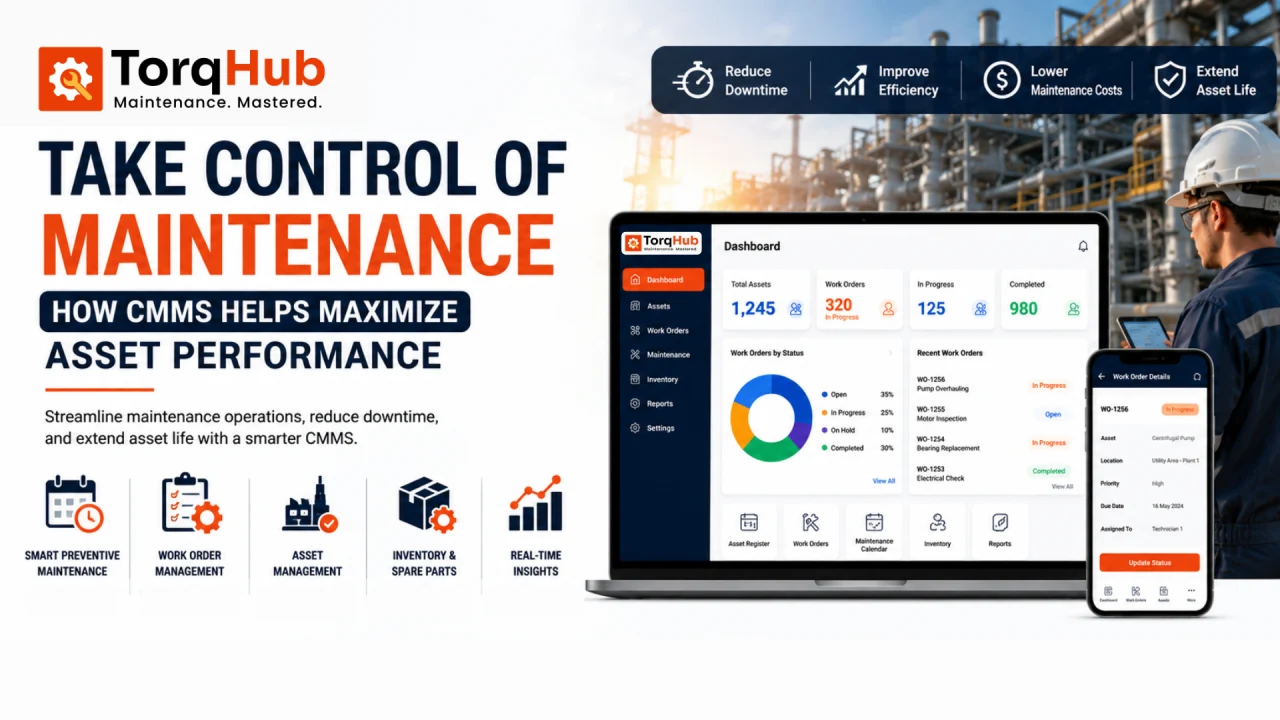
In today's competitive industrial environment, every minute of equipment downtime affects productivity, profitability, and customer satisfaction. Whether you're managing a manufacturing plant, commercial facility, warehouse, healthcare institution, or utility operation, maintaining critical assets efficiently has become a business priority rather than simply a maintenance responsibility.
Yet many organizations still rely on spreadsheets, paper-based records, disconnected software, or reactive maintenance schedules. These outdated methods often lead to missed maintenance schedules, unplanned downtime, poor visibility, and rising costs.
The solution lies in adopting a modern Computerized Maintenance Management System (CMMS).
A CMMS centralizes maintenance operations, automates routine tasks, and provides real-time visibility into equipment health. Instead of reacting to equipment failures, organizations can proactively manage maintenance activities, extend asset lifespan, and improve operational efficiency.
In this article, we'll explore how a CMMS transforms maintenance management and why TorqHub CMMS is helping organizations take complete control of their maintenance operations.
The Challenges of Traditional Maintenance Management
Many organizations face similar operational challenges every day. Maintenance teams often rely on phone calls, spreadsheets, emails, or verbal requests. Maintenance histories are difficult to locate. Spare parts inventory isn't always accurate. Preventive maintenance schedules are often forgotten until equipment fails.
As operations expand, these issues become increasingly difficult to manage.
Common maintenance challenges include:
- Unexpected equipment failures
- High maintenance costs
- Poor visibility into asset health
- Delayed work order completion
- Inconsistent preventive maintenance
- Difficulty tracking technician performance
- Manual reporting and paperwork
- Disconnected maintenance lifespan
Without a centralized maintenance platform, maintenance teams spend more time reacting to problems than preventing them.
What Is a CMMS?
A Computerized Maintenance Management System (CMMS) is software designed to help organizations manage maintenance activities from one centralized platform.
Instead of relying on multiple spreadsheets and manual processes, a CMMS digitizes every aspect of maintenance operations. This includes:
- Asset Management
- Preventive Maintenance Scheduling
- Work Order Management
- Breakdown Management
- Spare Parts Inventory
- AMC Management
- Vendor Management
- Reports & Analytics
- Mobile Maintenance Access
The result is greater visibility, better planning, and improved maintenance performance across the organization.
Why Asset Performance Matters
Every asset represents a significant investment. Whether it's production machinery, HVAC equipment, pumps, compressors, generators, or facility infrastructure, these assets directly impact business operations.
Poorly maintained assets can lead to:
- Frequent breakdowns
- Reduced production output
- Increased repair expenses
- Safety risks
- Missed customer commitments
- Compliance issues
Maximizing asset performance isn't simply about repairing equipment — it's about ensuring assets operate efficiently throughout their entire lifecycle.
That's where CMMS makes a measurable difference.
1. Gain Complete Visibility into Every Asset
One of the biggest advantages of a CMMS is centralized asset management.
Instead of searching through folders or spreadsheets, maintenance teams can instantly access:
- Asset details
- Equipment location
- Maintenance history
- Warranty information
- Service records
- Asset condition
- QR or barcode identification
- Associated work orders
With complete visibility, maintenance managers can make faster and more informed decisions.
2. Move from Reactive to Preventive Maintenance
Reactive maintenance is expensive.
Waiting for equipment to fail often results in emergency repairs, production interruptions, overtime costs, and unnecessary downtime.
A CMMS enables organizations to automate preventive maintenance by scheduling maintenance tasks based on:
- Time intervals
- Running hours
- Usage cycles
- Asset condition
- Meter readings
Automated reminders ensure no maintenance activity is overlooked.
The benefits include:
- Reduced equipment failures
- Improved asset reliability
- Lower maintenance costs
- Longer equipment life
- Better production planning
Preventive maintenance transforms maintenance from a reactive function into a strategic business advantage.
3. Streamline Work Order Management
Efficient work order management is essential for every maintenance team.
With a CMMS, work orders can be:
- Created instantly
- Assigned to technicians
- Prioritized automatically
- Tracked in real time
- Updated through mobile devices
- Closed with complete maintenance records
Managers gain full visibility into every maintenance activity, while technicians receive clear instructions, reducing delays and improving accountability.
The result is faster response times and higher work completion rates.
4. Improve Decision-Making with Real-Time Insights
Maintenance decisions should be based on data — not assumptions.
A CMMS dashboard provides real-time visibility into key performance indicators, including:
- Equipment downtime
- Asset reliability
- Maintenance backlog
- Work order status
- Preventive maintenance compliance
- Technician productivity
- Maintenance costs
- Asset health trends
These insights help maintenance leaders identify recurring issues, optimize maintenance strategies, and continuously improve operations.
5. Extend Asset Lifespan
Every organization wants to maximize the return on its equipment investments.
Routine inspections, timely servicing, and preventive maintenance significantly reduce wear and tear.
With a CMMS, maintenance teams can:
- Monitor equipment health
- Track maintenance frequency
- Analyze recurring failures
- Schedule servicing before breakdowns occur
Proper maintenance extends asset life while reducing replacement costs.
6. Increase Technician Productivity
Maintenance teams perform better when they have access to accurate information.
Using a mobile-enabled CMMS solution, technicians can:
- Receive work orders instantly
- View maintenance history
- Upload photos
- Update job status
- Record completed work
- Capture digital signatures
- Close work orders from the field
This reduces paperwork and allows technicians to focus on maintenance rather than administration.
7. Reduce Maintenance Costs
Unplanned downtime is expensive.
Emergency repairs often involve overtime labor, rush spare part orders, production losses, and equipment damage.
A CMMS minimizes these costs by improving planning and maintenance scheduling.
Organizations typically benefit from:
- Lower repair expenses
- Better labor utilization
- Optimized spare parts inventory
- Reduced downtime
- Improved operational efficiency
Over time, these savings translate into a significant return on investment.
Why Choose TorqHub CMMS?
TorqHub CMMS is designed to help organizations simplify maintenance operations through automation, real-time visibility, and intelligent workflows.
With TorqHub, you can:
- Centralize asset information
- Automate preventive maintenance
- Manage work orders efficiently
- Monitor equipment health
- Track spare parts inventory
- Handle AMC management
- Generate insightful reports
- Access maintenance data anytime, anywhere
Whether you're managing a single facility or multiple locations, TorqHub provides the tools needed to improve maintenance performance while reducing operational costs.
Industries That Benefit from CMMS
A modern CMMS is valuable across a wide range of industries, including:
- Manufacturing
- Automotive
- Pharmaceuticals
- Food & Beverage
- Healthcare
- Facility Management
- Warehousing & Logistics
- Commercial Buildings
- Power & Utilities
- Oil & Gas
- Hospitality
Any organization that depends on physical assets can benefit from structured maintenance management.
The Future of Maintenance Is Proactive
Maintenance is no longer just about fixing equipment when it breaks.
Today's organizations are adopting predictive technologies, automation, IoT-based monitoring, mobile maintenance, and data-driven decision-making to improve asset performance.
A CMMS serves as the foundation for this transformation.
By centralizing maintenance operations, organizations gain better control over asset health, improve productivity, reduce costs, and support long-term growth.
Conclusion
Every asset plays a critical role in business success, and every maintenance decision impacts operational performance.
A modern CMMS helps organizations transform maintenance from reactive firefighting into proactive management, driving improvements in reliability, productivity, and continuous performance.
With TorqHub CMMS, organizations gain complete equipment visibility, streamline maintenance operations, and take control of proactive maintenance management practices.
If your organization is looking to improve equipment reliability, increase productivity, and get complete control over maintenance operations, now is the time to invest in a modern maintenance management solution.