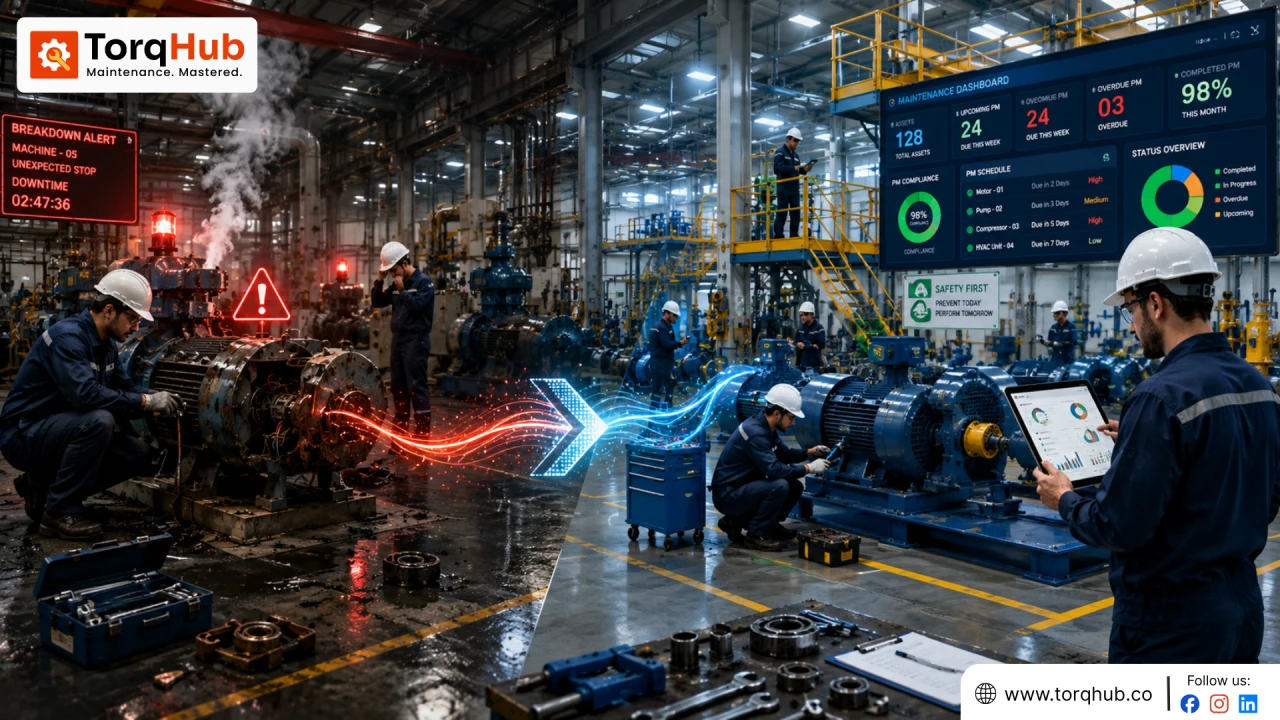
How Smart CMMS Automation Helps Maintenance Teams Stay Ahead of Failures, Reduce Downtime, and Extend Asset Life
Unexpected equipment breakdowns rarely happen at a convenient time.
A critical machine stops, production halts, and maintenance teams scramble to identify the problem. Spare parts need to be assigned, and technicians need to understand how long the equipment will remain unavailable.
The real problem isn't always the breakdown itself. Often, it's the lack of consistent preventive maintenance.
When maintenance schedules are managed manually through spreadsheets, calendars, paperwork, or disconnected systems, important tasks can easily be missed or delayed.
That's where preventive maintenance software and a modern CMMS (Computerized Maintenance Management System) can make a significant difference.
With TorqHub CMMS, organizations can move from reactive repairs to proactive scheduling, automated notifications, and streamlined workflows — all from one centralized platform.
The Hidden Cost of Reactive Maintenance
Reactive maintenance means fixing equipment after something goes wrong.
With emergency repairs sometimes unavoidable, relying on them as the primary maintenance strategy can create serious operational challenges.
1. Unexpected Equipment Downtime
A failed machine can interrupt production, delay inspections, and affect delivery schedules. The longer equipment remains unavailable, the greater the potential impact on productivity and revenue.
2. Missed Maintenance Schedules
Maintenance teams often manage dozens or even hundreds of assets. When schedules are maintained manually, inspections, lubrication, servicing, and replacement tasks can be overlooked.
One missed maintenance task can eventually become a major equipment failure.
3. Higher Maintenance Costs
Emergency repairs can require urgent labor, expedited spare parts, and additional resources. Preventive maintenance helps identify and address issues before they become expensive breakdowns.
4. Reduced Asset Lifespan
Equipment that doesn't receive timely inspections and servicing may experience excessive wear and premature component failure. Regular maintenance helps assets keep operating closer to their intended performance.
5. Too Much Time Spent on Administration
Maintenance teams shouldn't have to spend valuable hours checking spreadsheets, calling technicians, searching for service records, or manually updating maintenance status. Automation can reduce this administrative burden.
What Is Preventive Maintenance Automation?
Preventive maintenance is a planned approach to maintaining equipment before failures occur.
Instead of waiting for a machine to break down, teams schedule inspections, servicing, lubrication, component replacement, and other activities at defined intervals.
With CMMS preventive maintenance automation, these activities can be managed digitally.
A maintenance manager can define:
- Maintenance frequency
- Service intervals
- Asset-specific maintenance tasks
- Inspection checklists
- Responsible technicians
- Due dates
- Maintenance priorities
- Recurring schedules
The system can then help teams stay on schedule and maintain a consistent maintenance workflow.
How CMMS Automation Helps Prevent Breakdowns
1. Automate Preventive Maintenance Scheduling
One of the biggest advantages of a CMMS is automated scheduling.
Instead of manually creating maintenance reminders every week or month, teams can establish recurring maintenance plans based on predefined schedules.
For example:
- Daily equipment inspections
- Weekly lubrication
- Monthly servicing
- Quarterly inspections
- Annual overhauls
Once configured, maintenance activities can be tracked systematically. This helps reduce the possibility of important preventive maintenance tasks being forgotten.
2. Generate Work Orders Automatically
A preventive maintenance schedule is only useful when the required work actually gets completed.
CMMS automation can connect maintenance schedules with work orders.
When a maintenance activity becomes due, the corresponding work can be organized into a structured work order containing relevant information such as:
- Asset
- Maintenance task
- Priority
- Due date
- Assigned technician
- Checklist
- Work status
- Completion details
This creates a clear path from scheduled maintenance to completed maintenance.
3. Keep Technicians on Track with Smart Notifications
Maintenance teams are busy, a simple reminder can make a major difference.
Smart notifications help ensure technicians and supervisors are aware of upcoming or overdue maintenance activities.
Instead of relying on memory or manual follow-ups, teams can receive timely alerts when maintenance tasks require attention.
This helps improve maintenance compliance and reduces the risk of overdue preventive maintenance.
4. Use Digital Maintenance Checklists
Not every maintenance task is the same.
A preventive maintenance checklist can help technicians follow standardized procedures for specific assets.
For example, a machine inspection checklist might include:
- Check oil levels
- Inspect belts
- Examine electrical connections
- Check vibration
- Inspect bearings
- Clean critical components
- Record observations
Digital checklists make it easier to standardize maintenance procedures and document completed inspections.
5. Get Real-Time Maintenance Visibility
When maintenance information is spread across spreadsheets and paper records, managers may struggle to understand what's happening across the facility.
A CMMS dashboard provides a centralized view of maintenance activities.
Managers can monitor:
- Upcoming maintenance
- Completed tasks
- Pending work orders
- Overdue activities
- Asset status
- Maintenance trends
- Technician workload
This visibility helps maintenance teams make faster, data-driven decisions.
6. Build a Complete Maintenance History
Every preventive maintenance activity contributes to an asset's history.
A CMMS can help organizations maintain records of inspections, servicing, breakdowns, repairs, and other maintenance activities.
Over time, this information becomes valuable for understanding asset behavior. For example, if a machine repeatedly requires repairs to the same component, the maintenance team can investigate the underlying issue rather than repeatedly treating the symptom.
Preventive Maintenance vs. Reactive Maintenance
The difference is simple.
Reactive maintenance asks: "What failed, and how quickly can we repair it?"
Preventive maintenance asks: "What can we do now to reduce the chance of failure later?"
Reactive maintenance will always have a place in maintenance operations; however, organizations that combine emergency breakdown management with proactive preventive maintenance create a more resilient strategy.
The goal isn't to eliminate every breakdown — it's to reduce avoidable breakdowns and respond more effectively when failures do occur.
From Maintenance Tasks to Asset Reliability
Preventive maintenance shouldn't be viewed as just a list of scheduled tasks — it is a strategy for improving asset reliability.
When maintenance teams consistently inspect, service, and monitor equipment, they gain a better understanding of asset condition and performance.
This can lead to:
- Fewer unexpected failures
- Reduced downtime
- Better equipment reliability
- Improved maintenance productivity
- Longer asset life
- More predictable maintenance costs
Over time, preventive maintenance becomes an important part of overall operational efficiency.
Why Automation Matters for Growing Organizations
As an organization grows, its asset base usually grows too.
Managing 20 machines manually may be possible. Managing hundreds of assets across multiple locations is a different challenge.
That's where automation becomes increasingly valuable.
A modern CMMS software solution can provide a centralized system for managing preventive maintenance across assets, technicians, work orders, schedules, and maintenance records.
Instead of asking, "Did we remember to service this asset?" teams rely on a structured digital maintenance process.
Transform Maintenance with TorqHub CMMS
TorqHub CMMS helps organizations move from reactive maintenance to proactive asset management.
With features designed for modern maintenance operations, TorqHub can help teams manage preventive maintenance schedules, work orders, breakdowns, spare parts, and other maintenance activities from one centralized platform.
The result is a more organized maintenance workflow with better visibility and greater consistency.
With TorqHub, maintenance teams can:
- Automate preventive maintenance schedules
- Create and manage work orders
- Track upcoming and overdue maintenance
- Standardize maintenance checklists
- Improve team maintenance history
- Improve technician productivity
- Reduce unexpected equipment downtime
- Extend equipment and asset life
Stop Chasing Breakdowns. Start Preventing Them.
Unexpected breakdowns don't have to dictate your maintenance strategy.
By automating preventive maintenance, organizations can shift their focus from constantly responding to breakdowns to proactively managing equipment health.
The right CMMS preventive maintenance software can help maintenance teams stay organized, reduce unplanned downtime, and ensure critical maintenance activities happen when they should.
Don't wait for the next breakdown to expose a missed maintenance task.
Start building a more organized maintenance strategy with TorqHub CMMS.