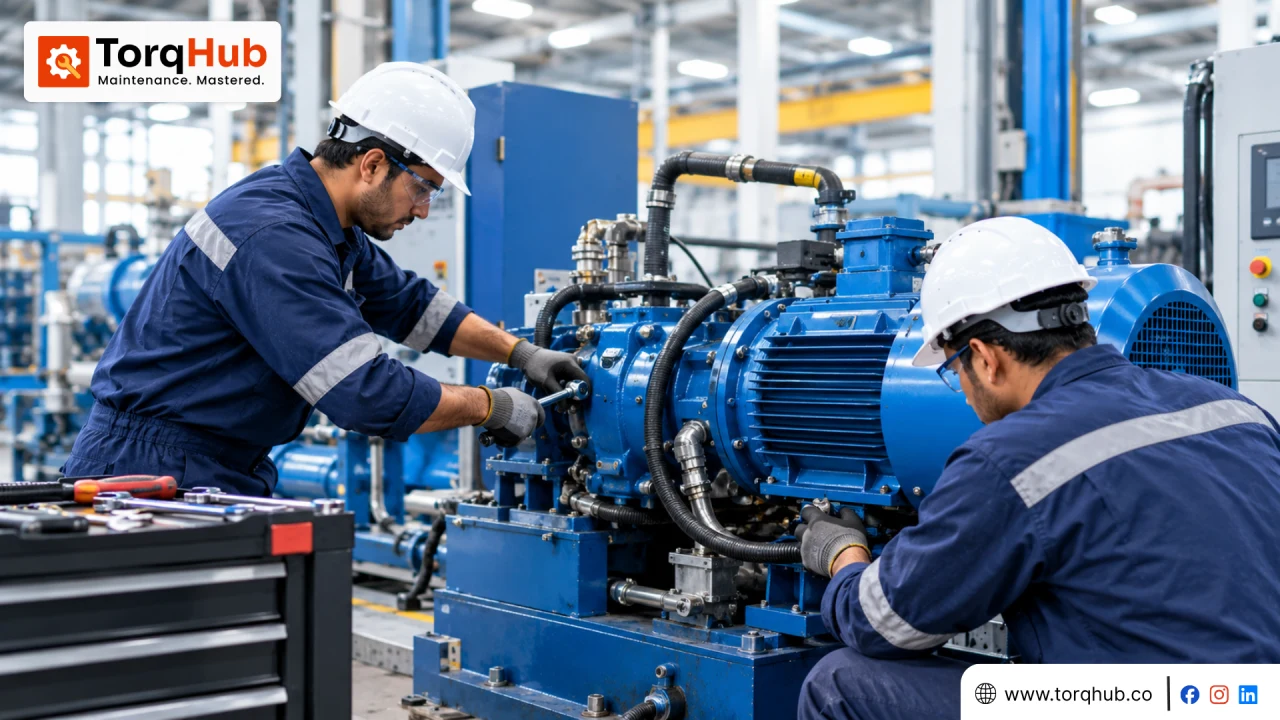
When a critical machine breaks down, every minute matters.
A late breakdown report leads to a late technician response. A late diagnosis stretches equipment downtime. And without proper repair records, the same failure can easily happen again.
For maintenance teams, the challenge is not just fixing equipment. It is responding quickly, coordinating efficiently, recording what happened, and using that information to prevent recurring failures.
A digital breakdown maintenance management system brings breakdown reporting, technician assignment, repair tracking, spare-parts usage and analysis into one centralized workflow.
What Is Breakdown Maintenance Management?
Breakdown maintenance management is the structured process of handling equipment failures, from the moment a fault is reported until the repair is completed and reviewed.
A typical process looks like this:
Breakdown Reported → Job Order Created → Technician Assigned → Repair in Progress → Work Completed → Closure & Analysis
The goal is to make every step visible, accountable and traceable. With a CMMS such as TorqHub, this lifecycle is digitized, so teams can respond to failures faster and keep a complete record of every breakdown.
Why Traditional Breakdown Management Creates Delays
Many maintenance teams still rely on phone calls, WhatsApp messages, spreadsheets, paper job cards or informal communication to report equipment failures.
This creates several challenges:
- Delayed breakdown reporting
- Difficulty prioritizing critical failures
- Slow technician assignment
- Limited visibility into repair progress
- Missing spare-parts information
- Incomplete repair history
- Difficulty identifying recurring failures
- Limited data for measuring maintenance performance
When information is scattered, maintenance managers spend valuable time finding information instead of resolving the problem.
How a Breakdown Maintenance Management System Improves Repair Response
1. Report Breakdowns Instantly
The first step in reducing downtime is shrinking the gap between failure and reporting.
A digital system lets operators report a problem from a mobile device, add a fault description, set the priority and attach photos. TorqHub's breakdown management module supports mobile reporting with fault descriptions, priorities and photo attachments.
Result: maintenance teams receive structured information immediately, instead of waiting for manual communication.
2. Alert the Right Technicians Immediately
Once a breakdown is reported, the maintenance team needs to know about it right away. Real-time notifications alert maintenance managers and technicians as soon as a breakdown is registered, which cuts communication delays and speeds up assignment.
The workflow becomes: Report → Alert → Assign → Respond
rather than: Report → Phone Call → Search for Technician → Follow-up → Assign
That difference matters a great deal when critical equipment is down.
3. Create Structured Work Orders
A breakdown should not remain an informal request. Converting the reported failure into a formal job order creates a clear maintenance task with a reference number, status, assigned technician and repair information.
TorqHub structures breakdown handling through an eight-stage lifecycle, from reporting and job-order creation through technician assignment, repair execution, completion and closure. Combined with work order management, managers get a clear view of what needs to be fixed, who is responsible, and where the job currently stands.
4. Track Repair Progress in Real Time
Once technicians begin working, managers need visibility. A digital breakdown management system can track:
- Work in progress
- Time spent on repairs
- Pause and resume activity
- Technician reassignment
- Completion status
- Resolution notes
TorqHub supports real-time status tracking, time logging, pause/resume workflows and technician reassignment with the history retained. This keeps repair jobs from disappearing into an information gap after assignment.
5. Track Spare Parts Used During Repairs
A repair is not only technician time. Spare parts and materials add significantly to maintenance cost. When usage is recorded against the asset and the work order, teams can see:
Which part was used → For which asset → During which breakdown → At what cost
TorqHub links spare parts consumed during repairs to the relevant asset and work order for cost tracking, giving better visibility into maintenance spending and recurring component failures. See how this connects with spare parts management.
6. Capture the Root Cause
Fixing a machine gets production moving again, but understanding why it failed helps prevent the next breakdown. Root cause analysis lets teams document:
- Failure cause
- Corrective action
- Spare parts used
- Technician observations
- Repair details
- Recurring failure patterns
TorqHub supports recording root cause, corrective action and spare-parts usage, helping teams spot recurring issues over time. It moves maintenance beyond repairing failures toward learning from failures.
7. Build Complete Asset Repair History
Every breakdown creates useful information. Over time, teams can build a detailed history for each asset:
Breakdown → Technician → Repair → Spare Part → Downtime → Resolution
TorqHub maintains repair history at the asset level, including breakdowns, technicians, parts used and time spent. That history supports maintenance planning, asset evaluation, troubleshooting and reliability improvement.
8. Measure Maintenance Performance
You cannot improve what you cannot measure. Important breakdown-management KPIs include:
- MTTR (Mean Time to Repair): the average time required to restore equipment after a failure.
- MTBF (Mean Time Between Failures): how frequently equipment fails.
- Breakdown Frequency: how often failures occur for specific assets or equipment categories.
- Downtime: how much operational time is lost because of equipment failures.
- Response Time: the time between breakdown reporting and maintenance response.
Tracking these indicators helps managers identify bottlenecks and see where improvement is needed. TorqHub's analytics and reports include breakdown reporting with MTBF and MTTR.
From Reactive Maintenance to Structured Breakdown Management
Reactive maintenance may be unavoidable when unexpected failures occur. But the way an organization responds to those failures can be managed.
A structured digital workflow helps maintenance teams:
Detect → Report → Prioritize → Assign → Repair → Record → Analyze → Improve
Instead of treating every breakdown as an isolated emergency, organizations can turn breakdown data into actionable maintenance information.
The TorqHub Approach to Breakdown Maintenance
TorqHub CMMS brings breakdown management together with other maintenance functions, including:
- Asset Management
- Preventive Maintenance
- Spare Parts & Inventory
- Work Order Management
- AMC Management
- Tools & Calibration
- Analytics & Reports
This connected approach lets breakdown information become part of the broader maintenance lifecycle, rather than staying in a separate spreadsheet or chat thread.
Key Breakdown Management Capabilities
- Instant Mobile Reporting: report failures with descriptions, priority and photos.
- Real-Time Technician Alerts: notify maintenance teams immediately.
- Structured Repair Workflow: track every stage from breakdown report to closure.
- Root Cause Analysis: record failure causes and corrective actions.
- Spare Parts Tracking: link parts used to assets and work orders.
- Photo Documentation: keep before-and-after repair evidence.
- Breakdown Analytics: monitor downtime, MTTR, MTBF, trends and maintenance performance.
Conclusion
Equipment failures may be unexpected, but the response does not have to be unstructured.
A breakdown maintenance management system gives teams the tools to report failures faster, alert technicians, manage repair workflows, track spare parts, document root causes, maintain asset history and measure performance.
The objective is not simply to fix equipment faster. It is to create a process where every breakdown is reported, tracked, resolved, documented and analyzed.
With TorqHub CMMS, maintenance teams can move from scattered breakdown reporting to a connected digital workflow built for response visibility and maintenance control.
When equipment fails, every minute counts. Make every maintenance response count.